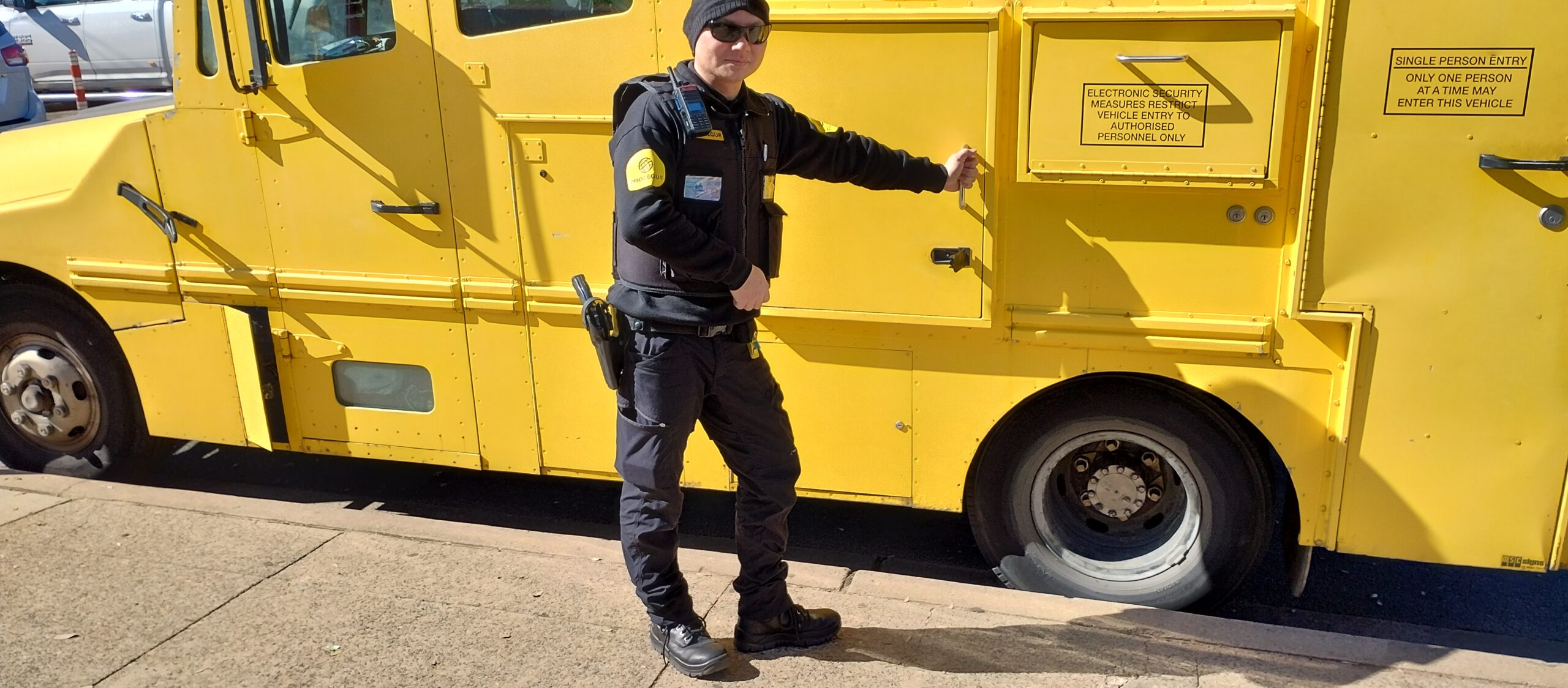
A Statement of Intent
The purpose of establishing a professional identity digitally is to outline my skills and expertise in the security sector. This was achieved with a further development on training to exclusively develop my career: This graduate certificate in Professional practice from University of New England was an approved course for study by my employer for the prospect of career development and professional suitability. However, my skills and experience include customer service, Telecommunications, IT, management, retail services combined to provide an exceptional service which has spanned over several decades. My previous experience working in a related field included studies for a Diploma in IT (PC and Network Support), Bachelor of Arts (Major in Politics) along with other work related training including LinkedIn for specific skills and knowledge.
Artefact 1: Question everything
This artefact in my opinion is used on a daily basis and it extends beyond a professional practice. It is insightful and touches on the realm of emotions and psychology that is intriguing by leveraging the topics I have learned and applied in a professional context. Working in a service-oriented environment, applying the six hats is a fundamental part of my role. Involved with face-to-face customers, interaction is mostly done with cadets checking for their mail delivery. In most instaces their package arrives however, there are times their package has not arrived based on the text or email message received from their courier. The cadets or staff member may use the red hat approach by showing their anxiety and the cost of that package. They may even imply their courier has delivered their package and somebody has signed for that package only to find out we don’t have their package: this effectively makes the cadet or staff enter into the black hat zone on the premise we may have a flaw or some mishandling with their package.
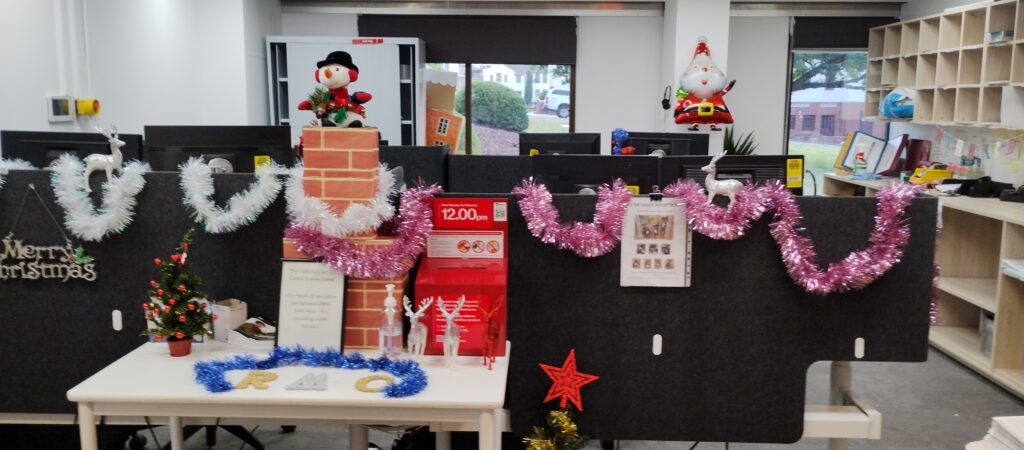
Service counter at RMC during Christmas break
In this instance, I will put the white hat on by asking the cadet or the staff member about the nature of the message they have received. The use of the white hat as an initial response is to gather information from the member to understand their situation such as the time and date the message was received or delivered. Once the necessary information has been gathered, I would then proceed with the blue hat, and look at process control. Since we do not accept deliveries from ordinary courier company with the exception of Defence registered and approved courier companies, otherwise all deliveries are delivered to Defence mail centre for processing before re-distributing to Defence locations. In most cases, the message is usually the time and date our Defence mail have received the members deliveries from their courier company and is now the subject for processing. Once that process has been established, I will then proceed to the yellow hat by advising members with the positive news that their mail is now at the processing facility and may take up to three days to arrive: but do check daily though.
After the third day, if their delivery has not been delivered to our site, then the member will be provided the contact details for Defence mail centre to track their mail. I will then use the green hat to provide some creative solutions for example, to check if their delivery has been picked up by other members of the same unit or the package were consolidated into in a class that may have conducted their training out in the fields. I will also look around in our delivery section to make sure they have not been accidentally placed in the wrong area: this means for example, their delivery was placed in the wrong class, or in the wrong pigeon hole such as the military band, chaplain, museum, cell ops as examples. So, using the six hats in this example, this has demonstrated a complete process and methods of control to achieve a preferred outcome and consistent with Defence values. Even though this is part of daily operations, nonetheless it shows the team is capable by wearing the right hat for that particular situation.
Reflection with Artefact 1 – Question everything
Doing the mail delivery when rostered on for that morning is a good attribute in that role. The main advantage when rostered for mail duties is the pressure it alleviates from other rostered duties. For example, when I am rostered for mail duties, I will place the mail activity in the software that records each activity. Since mail is subjective and currently a core function of our role, there is no KER (key expected results) or KPI (key performance indicators) to benchmark against: we just have to make sure the mail duties are running smoothly. This task could take a few hours to half a day or more depending on my working location: RMC – Royal military College has smaller mail duties whereas ADFA – Australian Defence Force Academy has significantly larger mail duties. ADFA has two mail runs a day meaning we get two deliveries a day and usually assign a staff member for each delivery. To reflect and improve our service by not letting old deliveries pile up and taking space, we are referring to our Defence mail procedures policy handbook. The aim is to hold items for up to 30 days, and that should be enough time if members have been posted, have left for operation or have taken leave. After the member has been notified and have gone beyond the thirty days, their delivery will be returned back to sender.
Artefact 2: Career Game plan
Undertaking this graduate certificate is a key pillar to my career progression. Since this course was approved by my employer for study, the course fee could be reimbursed once I have passed the subject by invoicing my employer. Upon receiving my graduate certificate, I will gain approval for recording my completion into my Australian Defence Organisation (ADO) Service record. This will assist me with moving within the organisation and showing my potential new supervisor my qualifications recorded in my service record. My current career plan is centred around this graduate certificate as it would assist with increasing my chances either in secondment, higher duties, promotion or moving within the organisation. Undertaking this study reflects on my Performance Feedback Assessment and Development Scheme (PFADS), as it is recorded in my activities and thus increases my chance of securing the maximum pay raise allowable or a lump sum depending on my APS pay scale. Within my PFADS, there are metrics such as key performance indicator (KPI) and key expected results (KER) based on the expected performance I should be achieving to remain an effective employee. The cycle of PFADS is annually and has three cycles: start cycle that begins on the first of September of current year, mid cycle and the end cycle ending on the thirsty first of august in the next calendar year.
This directly correlates with the work of Tony Watts with this planning work model based on DOTS: Decision making skills, opportunity awareness, transition strategies and self-awareness. With the decision making skills, attributing the decision to undertake this graduate certificate was a smart plan because it was measurable, achievable, and a realistic timeframe that could be encapsulated in my two PFAD cycles. To assess the strength of me making this decision to undertake this study is by showing my commitment to my organisation by developing my career. The weakness to this decision is the number of hours needed to commit to this graduate certificate. Time spent so far have included every opportunity available to study and meeting the curriculum requirements: just about every weekend this year has been sacrificed for this graduate certificate studies. Notwithstanding, the opportunity from this certificate will genuinely enhance my capacity to develop my professional career much further. It is a testament for example, staff cadets undertaking their degree at ADFA for the army, then upon completion of their degree, they enrol to RMC for leadership or a specialists training in their chosen field. They would then graduate and have the opportunity to be promoted to the position of lieutenant in their new posting location. The threat to my studies though, would be all this sacrifice I made during the semester and I end up failing a subject thus, I will not be able to invoice my employer. They only reimburse a completed subject meaning that failed subject would come from my own pocket. Having a failed subject would require an additional uptake of a subject and this would delay my professional development.
Reflection with Artefact 2 – Career Game Plan
This career game plan is currently in progression from my graduate certificate study. The span of this study into two PFAD cycle suggests it plays a vital role with my overall review on performance to be an effective employee. The pay increase for being an effective employee, though not directly related from this course study, does have a correlation and written in sections of the PFAD outlining my continued training. The DOTS from career game plan outlined the structure of me undertaking this course and have allowed me to self-assess any upcoming or likely opportunities, cope better with transition changes and remain an effective employee. My career plan has been established within my organisation and I am likely to hone in on my skills through training going forward. They actively support training for further improvement on efficiency with new systems, procedures or adapting to legislation changes. Part of the DOTS model in transition strategies include networking people or with stakeholders. To me, this is an essential part and will assist with spotting opportunities that may arise or stumbling into a particular problem and provide guidance or some assistance. I believe I will continue to develop my professional career and completing this graduate certificate will be a great enabler.
Artefact 3: The future of Work
I find the future of work quite intriguing. I entered the workforce in the mid 90’s and have seen the transformation of Businesses going online in droves over the decades, registering domains, and the use of emails which is a normal practice these days. Fax machines are now a thing of the past, and I remembered using these machines to send and receive purchase orders from clients. The nature of work is ever evolving for me, I have two jobs, one is an APS full time and another is working in a private security company as permanent part time on limited hours. However, what started as a hobby and speculation back in 2012 was mining cryptocurrency Bitcoin and Litecoin. I was intrigued that these new forms of digital currency will become a disruptor and could change the way we think about finance, security and aspects of digital interaction. In 2020, I started a small business in crypto mining with a handful of rigs mining cryptocurrency. This to me is like a third casual job with some weeks of inputting more hours into the business than other weeks. Even though I run a small business, it’s the passion I have for this industry, and this involves with a lot of intricate things such as technology, electricity, efficiency of equipment, taxes, troubleshooting hardware / software, heat management and trading.
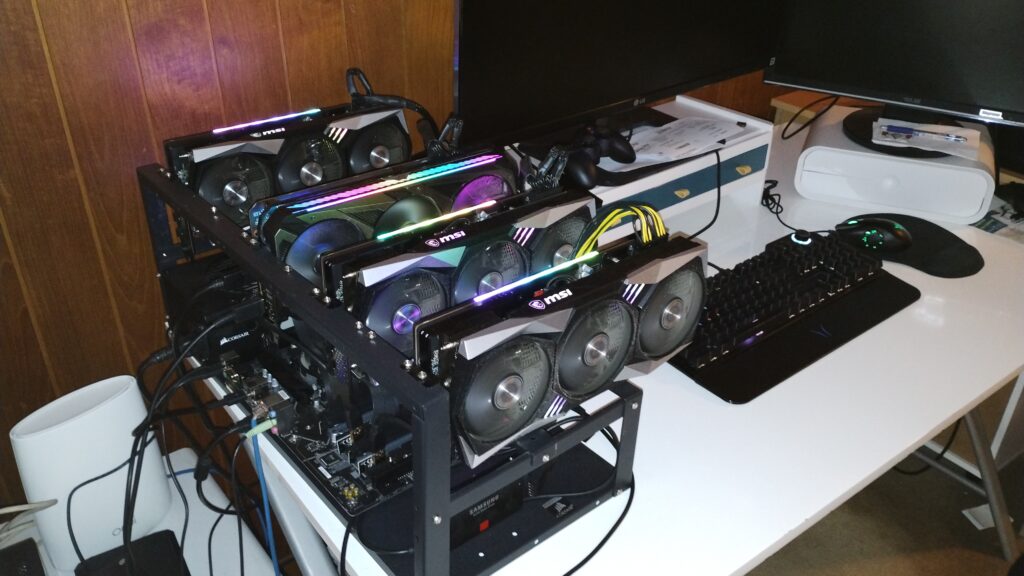
This is my desktop computer that can mine crypto and gaming.
To me, crypto mining fits well with the VUCA model: volatility, uncertain, complex and ambiguous. Crypto by nature is a volatile asset in terms of price chart, it is uncertain meaning for years, people couldn’t make sense of it and thought it was a pyramid scheme of some sort. But the truth is, bitcoin has solved the fundamental problem with double spending by utilising peer to peer network to settle transactions. It is ambiguous because crypto by nature was designed to operate outside the established financial instrument. Crypto to me is an evolution towards financial freedom by operating in a decentralised finance (DEFI) where smart contracts could be executed and managed digitally and governed by the layer one token. The future of digital finance will change the way we conduct our finances, and traditional financial markets will have to adapt or risk becoming irrelevant like the company kodak that failed to innovate and still retained their films for camera. The nature of work will change and I believe that cryptocurrency will play a crucial role by keeping current financial organisations honest knowing there are alternatives. Even the potential abuse of AI by spreading disinformation and causing harm could be curtailed and mitigated with blockchain technology to determine its original source. The future of work in my opinion is changing and the way we view traditional markets and its glaring flaws are widening. More countries have started to adopt the bitcoin strategy and a US presidential candidate recently stated that the use of bitcoin could be used to pay off the US debt. ETF companies like Blackrock have recently offered bitcoin as a strategy in their members investment portfolio. Cryptocurrency have stated to change people’s views and perception regarding investment at a fundamental level.
I want to be active in this space and I have recently changed my overall strategy this year. My small business on crypto mining overall fits well with the investor strategy, and this means I accumulate crypto assets based on the same principle of dollar cost average. When the market increases in price, then I will proceed to sell my crypto. I have been doing this mining for over ten years and will continue to do so. But this year, I have started swing trading as an additional form of work and not a hobby because this is a taxable event on capital gains. This means I need to research the markets, read the charts, subscribe to crypto news, with the goal of obtaining skills and knowledge on trading and managing risks.
Reflection with Artefact 3 – The Future of Work
Looking back when I first started mining crypto, it started as a hobby based on speculation and as an early adopter. I am glad that I have discovered bitcoin in its early days, and believe in its fundamentals that is governed by code and enforced by the mining rigs with transaction verification and no double spending. Bitcoin is not inflationary as it has a fixed number of coins that will ever exist at twenty-one million. Bitcoin in general has become mainstream with countries like El-Salvador using bitcoin as a legal tender. Other developing countries have begun mining bitcoin and keeping them as reserves with the hopes of avoiding IMF for loans because of the strings attached. But crypto in general will change the future of work in the most fundamental ways that I believe traditional industries will have to adapt in some capacity to stay relevant. New industries could include decentralised finance, decentralised cloud computing, smart contract, decentralised video content, gaming, non-fungible tokens, AI learning. Rewards could include staking, or in THETA’s case, you use your hardware to assist Universities with computing power needed for research. The future of work in my opinion is changing and people can now leverage their position for an outsized profit by developing this new emerging market.
Artefact 4: UNE Study Toolkit
The UNE study toolkit is rich with content and very informative by providing the best practice in the digital landscape. What I found to be the most intriguing was some of the content I took for granted in digital literacy. Well, my bias was I started to use the internet with dialup in the 1990’s and the search tool was Tucows, Alta Vista: Google didn’t exist yet. As the internet bandwidth grew and expanded geographically over the decades, new platforms emerged and the six elements proscribed in the deepening understanding have cemented digital revolution. For example, digital communication, collaboration and participation are technologies I actively use in my workplace. They include Skype to make phone calls, Microsoft Teams for meetings and sharing of documents or the creation of group and email channels for grouped communication. At my workplace, it is a mandatory requirement to keep up to date with learning and development courses to maintain access that is relevant to my role. Although my organisation is sensitive with members in the Defence force openly posting pictures in operations, military base or creating a persona that is unfavourable to the organisation. Notwithstanding, Defence does have a formal channel for communicating with the public.
Another aspect of developing digital literacy skills would be those skills that are lifelong and mostly recognised as universal worldwide such as the use of smart watch, computer systems, mobile phones and the internet. My secondary employment is working for a private security company involved with cash in transit business. The development of my role in that organisation was I worked at the depot but included the delivering of cash / coins in an armoured vehicle. Now, this organisation takes security seriously and they have security protocol that is layered. For example, when I do deliveries or collection of cash to banks, casinos, clubs and retail store, I wear a firearm to secure the transportation with large sums of cash in public space. The transportation has two security officers and each member has distinct roles. The digital security system I work with are backend technology installed in clubs, ATM, retails and banks. ATM’s for example has security features that require some technical experience and some digital communication competency with conducting cash replenishment. Before the merge of two Cash in transit company Prosegur and Armaguard, I worked at the depot and was in charge with security by securing large amounts of cash for banks, casinos, clubs and retails. That role required me to wear a firearm and to make sure all the cash were securely stored each night. When securing the cash for storage, the cash was placed in a hardened vault with multiple sensors and the main lock had a combination code and a special lock that works like an RSA token. That digital token code is then sent to National Operations Centre (NOC) for monitoring. Even though this role is a niche field in this digital space, from my point of view, security is paramount and the utilisation of digital technology would enhance security and in the event of an armed robbery or robbery at those sites, then response time would be much better with alerting authorities.
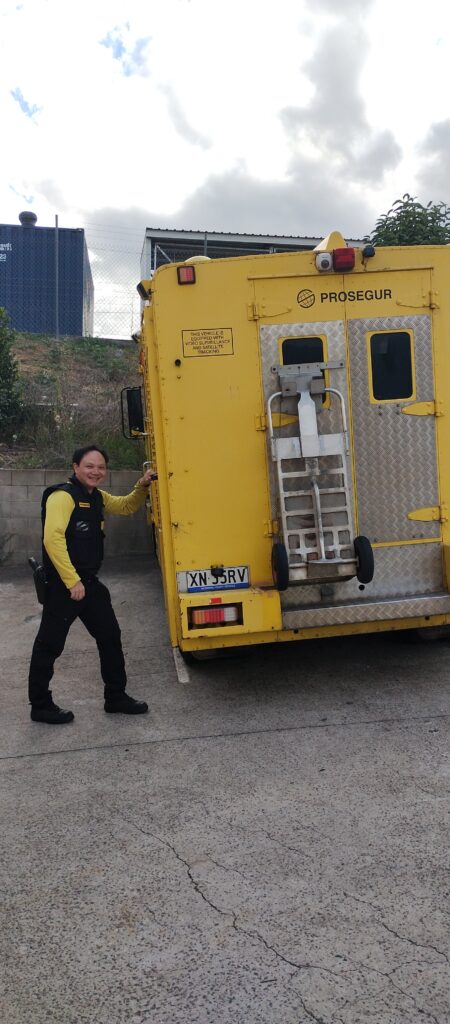
About to board the armoured vehicle
Apart from my workplace, I do not have a digital profile reflecting my persona, but I do have a Facebook account connected with family and friends, but that is mostly to stay in touch. However, with this assignment, it gives me a chance to create a digital persona reflecting my professional journey by utilising the CRAP approach: Currency, relevance, authority and purpose. Building this digital profile has currency as it would be the most up to date and it is relevant based on my requirements. It does not have however have authority as this digital profile does not need to be peer-reviewed and the purpose is to create a digital profile reflecting my persona.
Reflection 4 – UNE Study Toolkit
This study toolkit made me reflect back when I first journeyed onto the internet. Around the mid 90’s and at its infancy using dial up to surf the net, I remembered websites were mostly static with very limited features or rich with content. From there, there was an emphasis on anonymity when navigating online and thus, I have never created an online persona with the exception of creating Facebook account and Instagram account that centred around that platform. The main idea was centred around staying safe online and having a security conscious approach and not be a victim. From there, I had that mentality of keeping my footprint light on the internet to avoid scams, fraud and impersonation although scams and fraud have become sophisticated and I have fell victim to that unexpectedly via text scam based on my previous purchase with JB-HIFI. But overall, this assignment has taught me the six elements, the CRAP essentials, refresher in digital literacy and above all, evaluating information online such as peer to peer journal versus a news site or some personal blogger / youtuber. From this digital refresher, I will uptake the creation of a website for my small business in cryptocurrency mining to have some exposure and lists my business objectives.
Artefact 5: Conscious Influence
This artefact is an area that in my opinion will always require some constant evaluation in the role of leadership. This module on conscious influence provides guidance for aspiring members wanting to step up into the role of leadership, management or as an influencer: this module in my opinion covers the basis of leadership style and its approach. But first, with my public service role, I was recently enrolled for further training on a two day fully paid course called ‘Negotiation Skills’. This course was designed for people in position that requires a lot of negotiation with staff, stakeholders or in my case, I was recommended to participate this course because of my background as a supervisor. Completing that course will indicate to Defence that I understand Defence values and their expectation with members in a leadership role. The completion of that course will give me an opportunity to do higher duties when required to do so. Complimenting with this graduate certificate and this module on conscious influence will triage my leadership style with ever evolving and adapting to situations and with changes in the environment. For example, when supporting Defence Force members in a leadership role, they conduct training in a war-like scenarios and would use the VUCA approach: volatility, uncertainty, complexity and ambiguity. This could mean supporting the sub-ordinates as cadets in a broader strategy on VUCA in their travel arrangements or assisting with their entitlements, in a service delivery role.
With my background in leadership, I once worked as a Customer Service Supervisor for a car rental company. I was involved with daily operations within the business meaning vehicles had to be ready on time and the correct vehicle type for the customer. The focus was on customer excellence but generating revenue was paramount and I was part of the team to assist staff with incentives and upselling opportunities. This requires negotiation skills to communicate with staff to achieve the best outcome, as well with customers taking optional extras in their car rental like full cover. The leadership theory I believe to be the most utilised was the skills theory leadership, situational leadership, transformational and a small portion with transaction leadership. It is a skills theory because the role is hands on and requiring a can-do attitude to meet the business requirements. It is a situational leadership based on the hats I need to wear throughout the day for example at the airport with car rental booth, when flights come in, there would be a mad rush for customers wanting their vehicle and the queue could get quite long. Then there is the management of daily operations at the car park being congested with vehicles returning and outgoing. So, in this this instance, I try to be transformative and support staff of not getting stressed as the rental car park, road traffic, the long queue at the registers does look daunting and feels like chaos. At times, being transactional with customers during these peaks would be the most efficient without sacrificing customer excellence: customers usually have awareness of this situation.

Me in the external car rental booth as Customer Service Supervisor in 2010
Delving deeper into qualities that make a great leader with conscious influence, the qualities I want to bring to leadership as a way of transforming myself and my persona would be innovation, authenticity and insightfulness with my current role. Although I am not currently in a leadership role, there are goals in place for me to pursue towards that direction. The organisation I work for is based on vertical management and an emphasis on chain of command. The inspiration to this would be the loyalty from this style of management and the quality stemming from this would be discipline, integrity, authenticity, assertiveness, decisiveness and accountability. As leadership in Defence groups are stakeholders, interacting with military and civilian leadership would draw on distinct quality in their own domain: civilian leadership would generally focus on risk management, efficiency, bottom line, cost-benefit analysis, whereas military leaders would focus on tactical leadership, strategic direction, survivability, support and resistance.
Reflection Artefact 5 – Conscious Influence
Continuing to evolve and upskilling in this area has been constant and ever evolving in my career development. From the time when I was in a leadership position, I could draw some skills and experience obtained from the private sector but would need to adapt to a public service role in leadership. Some of my formal training from work and this particular subject has increased my capability and knowledge needed to increase my chance stepping into a leadership role either with secondment or with higher duties. The focus with this certificate is to increase my chances of building my career preferably in a professional and distinct environment in security. In other words, my goal is to apply, being seconded or in a higher duty at a higher APS level than my current level. Usually, a higher APS level would usually associate with leadership role for example, a level 4 would be a staff member and an APS 5 would be a team leader working in the same area responsible with daily operations. The main take is that I am not in a rush and do not have a timetable to be in a particular APS level by a certain time. The goal is that I have the capacity and capability to undertake higher duties or moving into another role in my organisation without placing a timeframe.
Artefact 6: Thriving in Chaos
To me there are various aspects of this theory that resonates with me and some that does not if taken to a wider context. This chaos theory, I usually do not think about its concept or its nuances or to use it as a reflection. Rather, I prefer to strategize and focus on building my career that is tangible, equitable and rational. However, this module does cover an area that I perhaps could take an intrigue since the way I understand chaos theory is usually from a scientific theory and the general theory of relativity. Prior to this, I would have categorised this concept as uncertainty, but would then hedge that uncertainty by limiting the variables and mitigating what I can to produce a range of options to hedge that uncertainty. Notwithstanding, this module contextualises the concept of thriving in chaos with Kromboltz theory with the five main ideas: curiosity, persistence, flexibility, optimism and risk taking of planned happenstance. Now, this theory does resonate with me in the sense that I may have come across an opportunity, being at the right time and the right place to launch a new exciting career. This is chance and serendipity and this opportunity was in 2003. At that time, I was a hardware / computer / server technician working with IT products. But my manager had a mate from another organisation that needed technicians in the telecommunications sector. Now that sector is a completely different sector, but they share the same networking principles on frame relays, transfer protocols and heat testing techniques. I got the job and initially worked on testing, technical troubleshooting and preparation on star token node projects. This equipment was the back haul of 3G networks using fibre optics and still used today with the NBN. From that experience, I was recommended as a telecommunications technician commissioning the back haul of 3G networks with every other equipment migrating to the 3G network. That role required travelling interstate and my area of coverage was NSW/ACT commissioning these projects at the Telstra exchange. So, to me, that was a serendipity moment that changed my career and I gained valuable experience in that field
Now the video clip in the study module on Celeste Headlee titled ‘Don’t find a job, find a mission’, to me was about someone in their zone. She knew what she wanted and used her trait quality being her voice to become a presenter. She wanted to keep using her voice as her primary job function and would want to continue with this for decades. From that passion, she created a persona and could reflect on that; even though she avoids reflecting. From my stance, I am building my career and I have to admit, undertaking this study graduate certificate is somewhat dreaded, as I have to devoted so much time and sacrifice so much weekends to keep up with my studies and tests, research, essays and assignments. And yet, when I graduate, it only increases my chances of getting secondment, higher duties or another role within the organisation. But to me, it is the logical path and my chosen career path is niche in the security sector and the content of this graduate certificate once completed, including the degree I completed previously would certainly assist with my career development. The paradoxical process of profiting from contradictions could assist me with crypto trading, I do that on the side, but my main business function is crypto mining. When trading, especially on margin and with leverage, emotions shouldn’t come into play. However, it does and that is an oxymoron because all the theories, charts and mind-space that I think I have garnered translates into a binary position of profit and loss. The only guiding principles to go by is obviously to buy low, sell high and remove some profits off the table. But sometimes, those profits go right back in when I spot an opportunity for trading and jeopardise the gains I have made. So, to me that paradoxical thinking needs to be cast aside and practice good habits in finance. So now for example, I stared with a thousand dollars for derivatives on future market trading with leverage, and when I made the first thousand dollars, I withdrew that amount and kept the remaining profits to continue to trade. And once the additional profits were generated, I would withdraw around twenty percent and keep the rest for trading. I hope I can keep to this momentum and not contradict myself.
Reflection with Artefact 5 – Thriving in Chaos
As I started with the opening comment in my collection of artefacts, I do not usually think about thriving with chaos. Normally I would look at content that is directly relevant to my interest or a needed qualification to obtain a license. For example, in order to wear a firearm for employment, the company must endorse me, I must get a certification and pass practical assessment: pass in shooting range, be competent at scenario training and understand the state / territory law. So, in that sense, there is no chaos component to this, things must flow in a logical order for to me to obtain my license and to maintain that license such as renewal to stay employed. Perhaps I may have understood this module from a different context or other principles that conflicts with chaos career theory. Perhaps I could look this theory as an extension to risk management and incorporate this in my professional career. My understanding in military terms as an example is that military planning is useless but there is a need to plan anyway. I do hope that the focus with my career goal will not blind side me for another opportunity.
Reflective Summary and Statement of Professional Practice Philosophy
Wow, this subject has been a journey for me. I have spoken to staff with our current process and proposed improvements with processes, and spoke to staff about my approved study. Some were intrigued about this opportunity and could apply for study next year to improve their career prospects and another may pursue further study that coincides with their passion and beneficial to Defence in its diversity if approved. Overall, this subject has empowered me to assess myself properly by applying metrics and guidance that has the backing with theory. The modules in this subject showed theory with practical examples such as the Ted talks and an interview with people outlining the fundamental theories and its applications. The insight from each module in my opinion are some life skills that will help with navigating in uncertain times, or spotting an opportunity that is a career change. My take on the future of work is that the nature of work keeps evolving and we are now at the digital age and currently heading towards and grappling with the information age. The use of AI is now beating drums but I think with the technology of crypto and the blockchain, this technology once matured will keep the information age and AI at bay by keeping them honest. Furthermore, crypto could revolutionise finance, smart contracts, digital property rights, gaming, arts. After speaking with staff and friends, I came up with the idea with voting and each voter decision is recorded on a blockchain that is immutable. What this means is that it completely eliminates fraud in elections, and data recorded on the blockchain will provide extremely accurate data. New tools could be developed to extract those data for meaningful products, and people will use it and trust it because of data integrity. Well, that was my creativity and thriving in chaos.
With this graduate certificate, the fact that it was approved by my employer for study is to benefit their organisation and that assumption is correct. When I delve deeper into questioning everything, even though my organisation has approved it based on merits and with their cost and benefit analysis, their pool of money for education and training is in fact from an approved public money anyway. However, for my personal development, working towards this graduate certificate is a milestone as the Australian Qualifications Framework place the graduate certificate at AQF level eight. When I reflect on this professional journey, this graduate certificate will play a key role that will enable my career development and be taken into account for professional suitability. The subjects I have chosen that makes up this certificate could all be utilised and be part of masters if I ever decided to pursue this further. I will take this one step at a time and reflect along the way with my career journey.